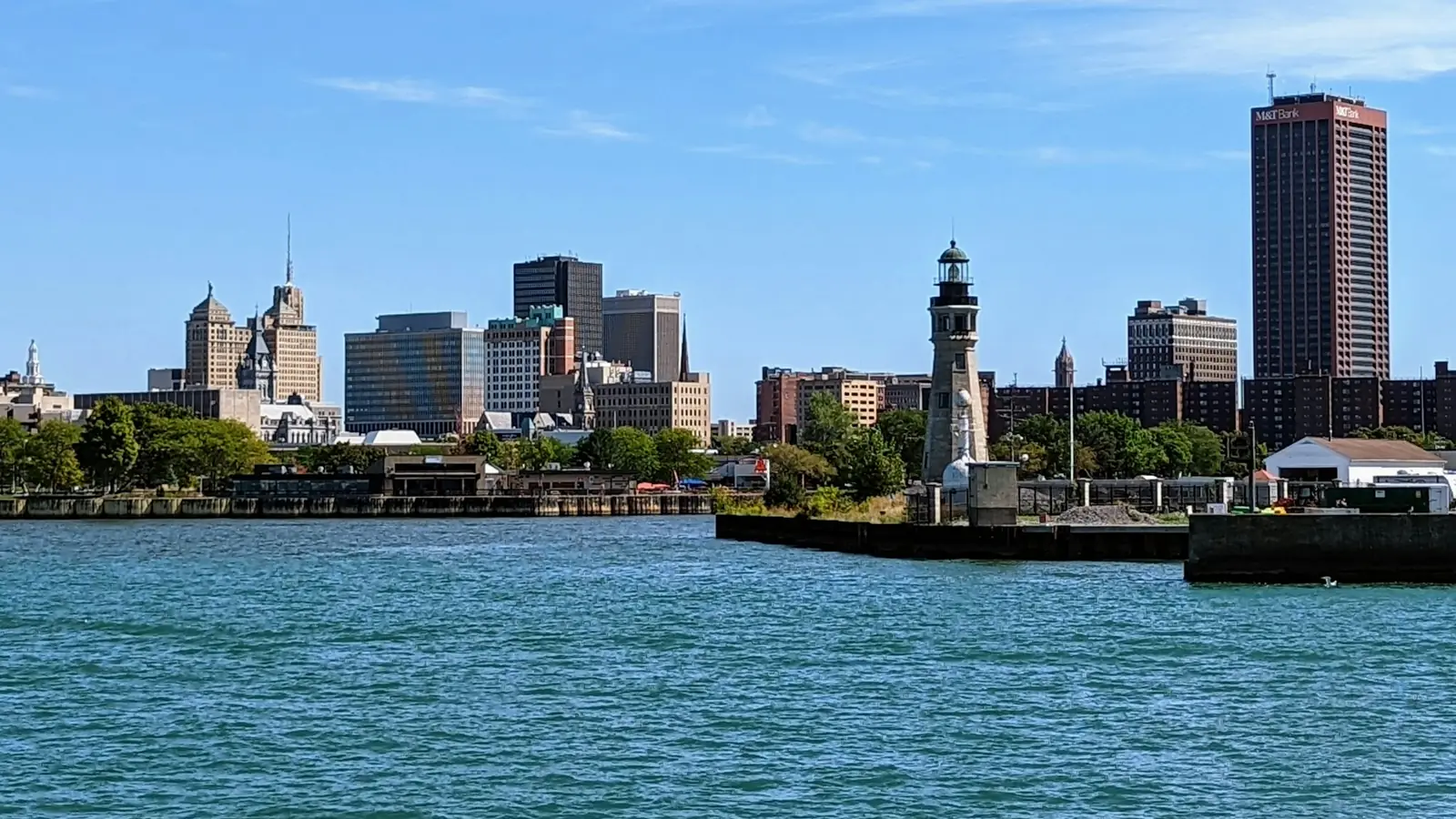
Buffalo and the rest of Erie County
Mold removal and water damage help in Buffalo, NY
Black spots on the basement block, a musty closet, a ceiling stain after the last thaw? Send one request instead of calling down a list. A local company that works your ZIP calls back, looks at it, and puts the scope and price in writing before any work.
- Mold and water damage, basement to attic
- New York's separate assessor and remediator licenses, explained
- Free to you: the local company pays us for the introduction
Free to youThe local company pays us
New York license rulesAssessor and remover kept apart
Water firstStop the moisture, then the mold
Erie CountyBuffalo and the towns around it
Water coming in right now?
Call or text, then do these three things while you wait.
- Turn the water off. The main valve is usually in the basement by the meter, where the line comes through the front wall. For one fixture, close the valve under it.
- Stay away from power. Don't wade into a basement with water near the panel or cords. If you can't reach the breakers from a dry spot, call your electric utility.
- Photograph it before you move anything. Wide shots, plus the water line on the wall. Then get boxes up off the wet floor.
Roof leaking after a big snow? What the week after a storm does to roofs and basements.
The local numbers
59%
of homes in the city's ZIP codes went up before 1940, against 14% in the suburban ZIPs (Census ACS 2020-2024). Old foundations, old drain lines.
11.9
thaw days a year at the airport (2016-2025 average): rain on snow, or a fast melt. 83% fall between December and February.
58
days a year with a dew point of 60°F or more (2016-2024), humid enough to sweat on a cool basement wall.
24
active New York mold remediation contractor licenses at an Erie County address, plus 21 assessment licenses (NY DOL, October 29, 2026).
NOAA daily data through October 28, 2026; Census ACS 2020-2024; NY Department of Labor via data.ny.gov. Look up your ZIP or read the method.
What we can help with
Five kinds of jobs, one request
Houses, doubles and apartments across Erie County. For a commercial building, say so in the request.
- Mold removal and remediationA NY-licensed remediation contractor, working from an independent assessor's plan, after the water is fixed.How it works
- Mold inspection and testingWhat a licensed assessor checks, when testing is worth paying for, and why the inspector can't do the removal.How it works
- Basement mold and wet basementsPrewar walls, the December thaw and July dew points. Drying the basement and keeping it dry.How it works
- Attic mold removalDark sheathing, frost on the nails, ice dams after a lake-effect storm. The cause first, then the cleanup.How it works
- Water damage restorationBurst pipes, ice dam leaks and backed-up drains. Getting it dry before mold starts.How it works
New York Labor Law, Article 32
One job, two licenses, three steps
- Assess. A licensed mold assessor inspects and writes the remediation plan: which areas, how much material, what methods, what counts as clean, and an estimate. (Section 945.)
- Remediate. A licensed remediation contractor does the work under that plan. On the same property the assessor and the remediator can't be the same company, and nobody can own a piece of both. (Section 936.)
- Clear. The assessor returns for a post-remediation assessment and writes a passed clearance report, or a status report listing what's left. (Section 947.)
Covers projects over 10 square feet (section 930). Homeowners working on their own home are exempt (section 933). In force since 2016. Not legal advice. The longer version.
Why this matters here
New York is one of the few states that licenses mold work
In most states anybody with a sprayer can call himself a mold specialist. New York doesn't allow that, and it splits the job in two: whoever tells you what's wrong may not be the one paid to fix it. The logic is easy to follow. "You need $12,000 of remediation" is a very comfortable sentence for the person who would be doing the $12,000 of remediation.
Statewide there are 958 active remediation contractor licenses and 810 assessment contractor licenses. 212 companies hold both, which is allowed; they just can't do both halves on one property.
What we ask of every company we refer
Four things to expect
Mold jobs go wrong in familiar ways, usually a missing plan or a leak nobody fixed. We ask for these up front. If a visit falls short, tell us at (716) 300-6502.
- The state license number, before anyone signs. Remediation over 10 square feet takes a New York Mold Remediation Contractor License. Ask for the number and look it up on data.ny.gov; it takes a minute.
- Someone else's plan on bigger jobs. The company that removes the mold works from a licensed assessor's written plan and doesn't assess its own job.
- The scope and price on paper. What comes out, what gets cleaned, how long it runs, and the three business days New York gives you to cancel a home improvement contract.
- The water dealt with, then a clearance. Mold comes back when the leak or seepage stays. The assessor's clearance report is how you know it's finished.
Before anyone quotes you
What this work tends to cost
Published national ranges, not a Buffalo quote. Your job gets priced in writing before any work starts.
Already holding a quote? Hold it up against what a New York remediation plan has to list.
| Job | Published range | Source |
|---|---|---|
| Mold remediation, typical job | $1,500 to $9,000, $3,500 averageFixr, Aug 2025 | Fixr, Aug 2025 |
| Basement mold | $1,500 to $4,000Fixr, Aug 2025 | Fixr, Aug 2025 |
| Attic mold | $1,500 to $9,000Fixr, Aug 2025 | Fixr, Aug 2025 |
| Whole house | $10,000 to $30,000Fixr, Aug 2025 | Fixr, Aug 2025 |
| Mold inspection | $450 to $800, $500 averageFixr, Jan 2025 | Fixr, Jan 2025 |
| Water damage restoration | $1,200 to $5,000, $3,000 averageFixr, Jan 2025 | Fixr, Jan 2025 |
| Water extraction | $3.75 to $7.50 per square footFixr, Jan 2025 | Fixr, Jan 2025 |
National published figures from Fixr, not Buffalo averages and not a quote. On a New York job over 10 square feet, add the separate assessor's fee for the plan and the clearance check.
Original analysis of NOAA data
Why Buffalo houses get wet, and stay wet
Buffalo is famous for the snow, but snow sitting on a yard does no harm. The damage comes on the days it stops being snow. On about 11.9 days a year, by our count of airport records, rain falls on snow cover or a warm spell melts the pack fast. December has the most of those days, about 3.6, and December through February together average 9.9. The ground a foot down is often still frozen, so the meltwater runs along the surface to the foundation and into window wells.
Then comes July. The airport averages 44 days from June through August with a dew point of 60°F or higher. A basement wall against cool soil sits below that, so moisture condenses on it, and you get the musty smell people blame on a leak that isn't there.
Put both on a house built before 1940 with no exterior waterproofing, which describes a lot of the city, and you get the classic Buffalo basement: white crust on the block, black spots on whatever was paneled over it. Why Buffalo basements get wet.
Thaw days by month, Buffalo airport
Days with a dew point of 60°F or more, by month
Old houses, by ZIP code
Across the 46 Erie County ZIP codes we cover, about 30% of 426,589 homes were built before 1940. Inside the city it's 59%. The oldest is 14222 (Elmwood Village), at 78%, followed by 14213 (Upper West Side (Grant-Ferry), 75%), 14201 (Allentown and Lower West Side, 66%), 14203 (Downtown (south) and the First Ward, 66%).
Flood claims tell a creek story here, not a lake story. Erie County has 2,483 federal flood insurance claims on record, and 1,136 of them come from just two years: 723 in 1979, the year of a 4.89-inch September cloudburst at the airport, and 413 in 1985, when snowmelt and ice jams brought a federal disaster declaration. ZIP 14221 (Williamsville and central Amherst) alone logged 270 in those two years.
Share of homes built before 1940, the 14 oldest Erie County ZIPs (%)
Read before you call
Plain answers, with sources
Written for Buffalo homeowners and renters. Every guide lists its sources at the bottom.
- What mold removal costsPublished ranges by room, plus the separate assessor fee New York adds.
- New York's mold license lawAssessor, remediator, clearance: who may do which part.
- Is this mold quote fair?What a real remediation plan lists, and how padding shows up.
- Why Buffalo basements get wetThaw days, summer dew points and prewar foundations, from NOAA and Census data.
- After a big snow: thaw, ice dams and leaksWhat the week after a lake-effect storm does to roofs and basements.
- Mold in a Buffalo rentalThe warranty of habitability, the city's rental inspection law, and writing it down.
- Does insurance cover mold in New York?Sudden versus slow water, mold caps, and the sewer backup gap.
- Black mold, plainlyWhat the color tells you, what it doesn't, and what to do next.
- Cleaning mold yourselfWhen a small patch is a weekend job, and what not to spray.
- Buying a house with moldInspection findings in an old Buffalo house, and what to ask before closing.
Areas we cover
Buffalo and the towns around it
- Amherst14221 14226 14228 14051 14068
- Cheektowaga14225 14227
- Tonawanda and Kenmore14150 14217 14223
- West Seneca14224
- Lackawanna and Blasdell14218 14219
- Hamburg and Evans14075 14047 14006
- Orchard Park14127
- Lancaster and Depew14086 14043
- Grand Island14072
- Clarence14031 14032
- East Aurora and Elma14052 14059
Also every city neighborhood from Black Rock and Riverside to South Buffalo, plus Alden, Akron, Eden, Boston and Springville.
Questions Buffalo homeowners ask
How much does mold remediation cost in Buffalo?
Fixr's national figures put a typical mold remediation job at $1,500 to $9,000 (about $3,500 on average), or $10 to $30 per square foot. A basement runs $1,500 to $4,000, an attic $1,500 to $9,000, and a whole house $10,000 to $30,000. In New York a job bigger than 10 square feet also needs a licensed assessor, who is paid separately, so budget for the plan and the clearance visit too.
What are the laws in New York State regarding mold?
New York licenses mold work under Article 32 of the Labor Law, in force since 2016. For jobs larger than 10 square feet, a licensed assessor writes the remediation plan, a separately licensed remediation contractor does the work, and the assessor comes back for a clearance check. The same company may not do both the assessment and the removal on the same property.
Would homeowners insurance cover mold remediation?
Sometimes. New York's Department of Financial Services says mold is covered when it results from a covered event, such as a sudden pipe burst, and that many policies cap what they pay for mold remediation. Mold from long-term seepage or humidity usually is not. Flood needs a separate flood policy. Sewer or sump backup usually needs a water backup endorsement.
Can a house with mold be saved?
Almost always. Mold is a moisture problem with a cleanup attached. Fix the water source and remove what can't be cleaned. Clean the rest and dry the structure. Whole-house jobs exist, but Fixr's whole-house figure is $10,000 to $30,000, far below the cost of the house.
Who actually comes to my house?
An independent local company that works in your ZIP. Buffalo Mold Desk is a referral service: we pass your request along so you don't have to work through a list of numbers. For mold over 10 square feet, New York requires a licensed assessor and a separately licensed remediation contractor, and the company that calls will tell you which part it does.
Stop the water, then deal with the mold
One request, one local company, the scope and price on paper before any work.